

 Oil & Gas
 Maritime
 Power Gen
 Chemicals
 Mining
 Sewers
 Cement
 Nuclear
 Infrastructure
.svg) Transportation
Transportation


 EN
EN
How the Maryland Department of Transportation State Highway Administration Uses Drones
The Maryland Department of Transportation State Highway Administration has turned to drones to help inspect confined spaces and measure material stockpiles to help them react quickly to various scenarios.
The state of Maryland covers 12,407 square miles (32,133 square kilometers) with a population of over 6 million. The Maryland Department of Transportation’s State Highway Administration (MDOT SHA) maintains and manages over 17,440 lane miles of highway in the state. This monumental task helps keep citizens safe through maintaining roadways and responding quickly in cases of damage or accidents.
The MDOT SHA adapts its policies and operations according to the needs of the state and environmental factors. In periods of extreme rain, the MDOT SHA works to mitigate the impact of flooding, while in the colder months, the MDOT SHA mobilizes to spread salt and grit across roads prone to ice to protect the public and mitigate the occurrence of accidents. Alongside routine operations for monitoring the condition of roadways, it is crucial for MDOT SHA to accurately track their stockpiles of material, including grit, asphalt, and similar substances, to ensure they are equipped to deal with unexpected incidents alongside routine operations.
How does the MDOT SHA use drones?
No stranger to drones, the Maryland Department of Transportation’s State Highway Administration has been using drones for years to get quick situational awareness of highway projects, to map areas of interest, and to monitor incidents as needed. With a commitment to optimizing their operations, the MDOT SHA recently collaborated with the University of Maryland to research the optimal ways to inspect the insides of pipes. Pipe blockages can cause flooding, which the MDOT SHA wishes to minimize as much as possible. During their research, they found that various drone technology solutions could be used to inspect confined and inaccessible environments. This included the Elios 3 drone.
In the past, the MDOT SHA relied on external contractors to help them with confined space inspections. However, as the MDOT SHA UAS Program often collaborates with the Environmental Design, Surveys, Structures, Construction, Hydrology, and Communications offices, they were interested in a solution that they could deploy internally, on an as-needed basis. Data could be collected on their own in a safe, efficient manner without delays from bringing in third-party contractors.
The MDOT SHA’s established drone program marks the agency as innovative and ready to adapt to new technologies. The presentation of the Elios 3 through the University of Maryland demonstrated the potential for a new type of drone, specific to confined spaces, to join their fleet.
-1.png?width=1712&height=1008&name=image%20(15)-1.png)
In action: the MDOT SHA used the Elios 3 for a pipe inspection, identifying faults using the LiDAR (left) and 4K video (right)
What can the Elios 3 be used for by Departments of Transport?
The Elios 3 offers unparalleled access to confined spaces. It empowers users to gather multiple types of data simultaneously - including 4K videos, 3D models, and thermal imagery. This, in combination with its collision-tolerant design, makes it the ideal solution for remote data collection.
The applications for the Elios 3 span across industries, but example industries that could serve a government department include:
- Inspecting sewers and culverts running under or near roadways for condition assessments and emergency response
- Emergency response in the case of landslides or damage to tunnel systems
- Measuring volumes for stock tracking in the case of stockpiles
The Elios 3 solution can be deployed within minutes of arrival on site, offering either minutes or hours of flight time, depending on the use of batteries or the tether power unit. Data collected from the flight can then either be imported to Flyability’s Inspector software for analysis or uploaded to Flyability Cloud. Inspector allows for the generation of PDF reports, while Flyability Cloud enables easy sharing of results for quick, clear communication between departments.
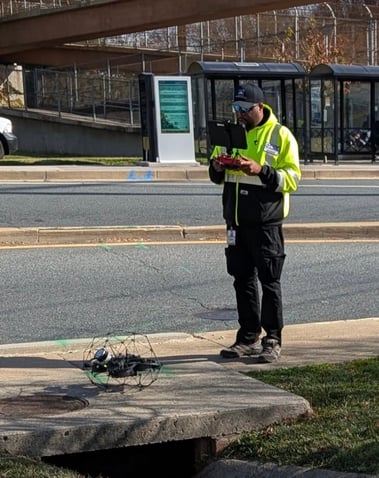 A pilot for the MDOT SHA prepares the Elios 3 for LiDAR data capture before entering a nearby manhole
How the Maryland Department of Transportation's State Highway Administration measures stockpiles with a drone
Following a rigorous testing and training period, the MDOT SHA integrated the Elios 3 with their drone program. The drone’s specific tasks are related to inspecting confined spaces and gathering data from hard-to-reach areas. The department is continuing to explore the work applications with the unique solution, with initial success in stockpile tracking.
In the past, an indoor stockpile measurement would require a member of the MDOT SHA to work with a consulting firm specializing in confined space inspections. The consultants would measure the stockpiles in the storage area with a mix of cameras and LiDAR scanners before presenting the results to MDOT SHA.
.png?width=1163&height=733&name=image%20(16).png)
A LiDAR scan taken with the Elios 3 of an outfall drain pipe from an overflow pond
With the Elios 3, a pilot from the MDOT SHA can go straight to the storage space and deploy the drone in minutes. The Elios 3 is then maneuvered around the piles via its camera view while the drone’s LiDAR Surveying Payload captures centimeter-accurate 3D models of the space. This data is then imported to LiDAR processing software, where the team can measure volumes and update records with accurate information.
The use of the Elios 3 in this way presents several key benefits:
-
The ease and speed of data collection empower the MDOT SHA team to conduct regular measurements with minimal disruption to work in the area. This results in a direct improvement to safety standards as the team can capture stockpile measurements in minutes without people climbing or being near the stockpiles.
- By collecting the data themselves, the MDOT SHA pilots can take complete control over the information. They are no longer reliant on the availability of consultants but can instead gather data on an as-needed basis.
What's next for this Drone Program?
The MDOT SHA already uses drones for projects and tasks within its purview. Drones are being deployed by the department for traffic monitoring, construction planning and monitoring, including fixed-wing drones for large area mapping and planning maintenance work. The Elios 3 is yet another addition to their extensive fleet, unlocking new capabilities alongside their existing toolkit.
Moving forward, MDOT SHA plans to keep testing the applications of the Elios 3 and training their team to use the drone alongside relevant software solutions to get the most out of this technology.
Interested in learning more about our drone? Head to the Elios 3 webpage!