

 Oil & Gas
 Maritime
 Power Gen
 Chemicals
 Mining
 Sewers
 Cement
 Nuclear
 Infrastructure


 EN
EN
2026 Guide to Drone Transport Inspections: From Bridges to Tunnels
Can drones be used to inspect transport infrastructure? Which drones are up to the task, and what are their limitations? We dive into it in our detailed guide for drone transport inspections!
Transport makes the world go round - and it's modernizing. Trains are faster, cars have gone electric, and subways are the most efficient way to move around most cities.
But their infrastructure hasn’t modernized at the same rate. In fact, the growing number of cars on roads is putting increasing pressure on bridges, tunnels, and highways as these structures age. Inspection methods haven't been updated either. A single bridge inspection can cost thousands of dollars in traffic disruption, safety protocols, and equipment rental - all to discover the bridge doesn’t need any maintenance work yet.
The solution to challenging transport infrastructure management is already taking off: drones for transport inspections.
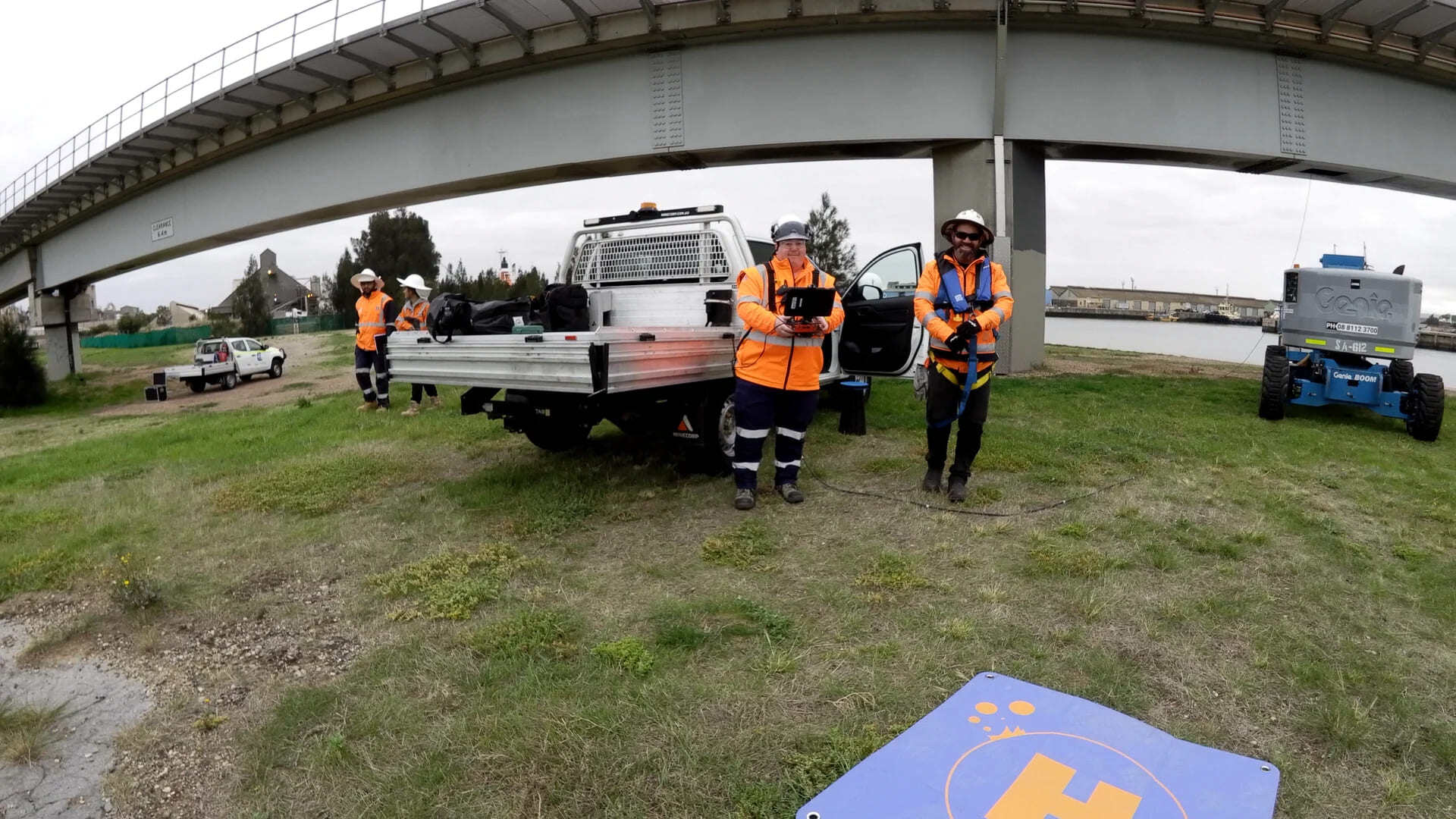
A view from the drone: getting ready to inspect a bridge. Read this bridge inspection case study
What are Drone Transport Inspections?
A drone transport inspection is the process of using a drone or unmanned aerial system (UAS) to assess the structural stability and condition of transport infrastructure, including bridges, tunnels, or affiliated buildings, such as train stations.
Using a drone for a bridge inspection, for example, would involve flying the drone underneath the structure to check for cracks, corrosion, or concrete spalling, instead of using cherry pickers or rope access to lower people to the bridge underside. This is substantially cheaper than traditional inspections as it requires less specialist equipment, smaller teams, and is generally a safer means of access.
Specialized inspection drones are being deployed by transport agencies and service providers to remotely gather data, including visual inspection data, ultrasonic thickness measurements, and LiDAR point clouds for 3D models.
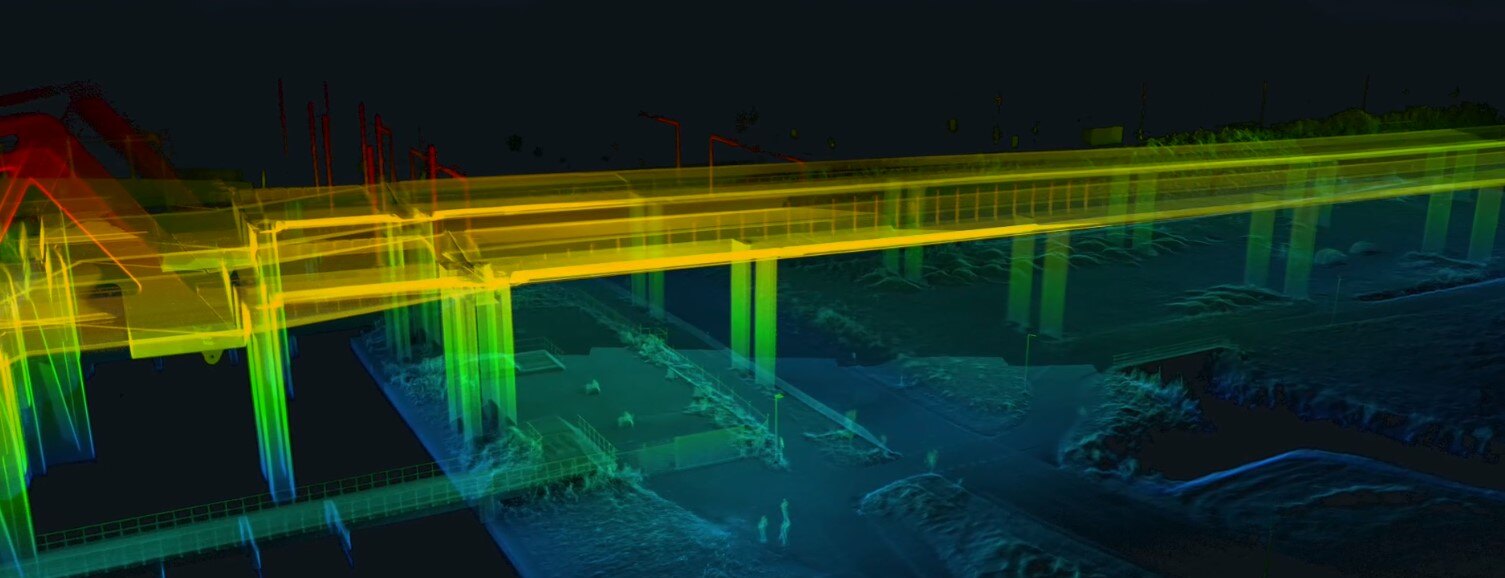
A LiDAR point cloud is a powerful tool for digitizing and assessing assets after an inspection
What are the Benefits of Drone Transport Inspections?
Drones are rapidly changing the industrial inspection space for the better, delivering critical benefits that streamline work and improve safety standards.
The top 3 benefits of drone transport inspections are:
Safety
Safety is paramount to any industrial inspection. The use of scaffolding, cherry pickers, or rope access to reach areas at height presents many safety hazards that are addressed through special protocols and licenses. Now, with drones, transport infrastructure can be inspected without the need to work at height or in confined spaces. The improved safety standard also speeds up the inspection time, making it easier to complete assessments more frequently and thus get better insights into asset conditions, improving overall infrastructure maintenance practices.
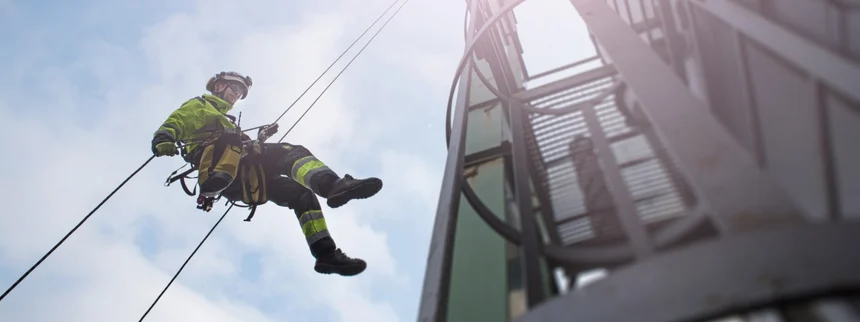
Rope access, scaffolding, or cherry pickers all require special safety protocols and equipment to protect inspectors, making them time-consuming and expensive.
Speed
Many transport inspections take place at night or in gaps between traffic, requiring quick data collection and rapid responses from inspectors. A drone can be deployed in minutes and an inspection completed in less than an hour - a rapid turnaround even in complex environments. In fact, inspection teams operating in rail tunnels reported they could inspect 8 ventilation shafts in the time traditional rope access takes to complete 1 shaft inspection. Drones require less additional equipment, less disruption to traffic, and provide safer inspection conditions, all of which culminate in a faster inspection process for transport infrastructure.
As technology has evolved, drones can now even use automation features to speed up data collection. During data processing, AI can automatically identify defects in the videos and images captured by the inspectors. For data collection and inspections themselves, drones can use customized autonomous features to streamline data capture. For example, using "AutoScan", certain drones can automatically collect image data for photogrammetry, ensuring the right overlap between images and a consistent ground sampling distance (GSD). Read all about autonomous drone bridge inspections!
Downtime
The phrase “time is money” is epitomized in transport inspections: every delay could have a knock-on effect that impacts thousands of passengers and millions of dollars worth of goods. Shutting down a road or railway requires months of planning and permission, including coordination between multiple teams and agencies. Drones change that. A drone inspection can be completed in minutes during periods of little-to-no traffic and without having to disrupt the flow of people or goods. In addition, the quality of the data collected by drones results in clear analysis and easier maintenance planning, which in turn empowers clearer planning and communication. The result? Both inspections and maintenance work are faster and more efficient than ever.
A drone inspection for transport infrastructure - whether it’s a bridge, tunnel, or building - will deliver faster, safer, and more cost-effective results to inspectors. Not only that; drones are a modern solution and can help bring asset management into the modern era by delivering digital twins and detailed 3D models. This empowers the transition from outdated records and hand-drawn diagrams to Industry 4.0 practices, such as Digital Twins or Scan to BIM. Safety, speed, and reduced downtime are just a few of the many benefits of drone inspections for transport, and the results are proven! Drone inspectors have reported that they can reduce traditional inspection costs by up to 75% by using drones! Drones are here to stay - so how do you select the right one for your operations?
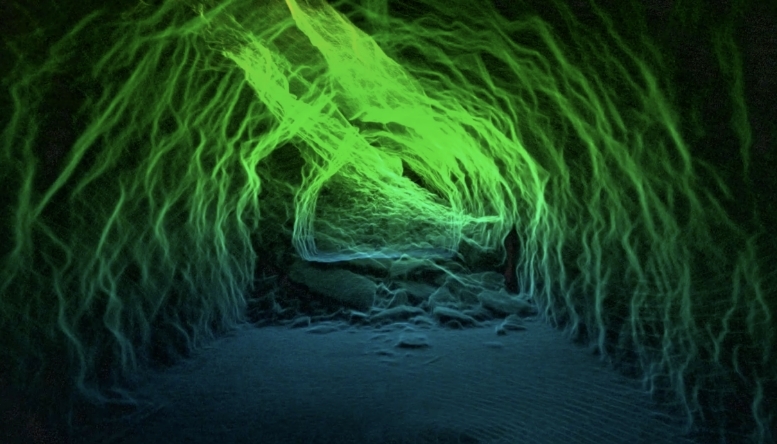
It is vital to reduce downtime when inspecting infrastructure- even in cases of emergency response. Read this case study about how drones were used a landslide damaged a road tunnel.
What's the Best Drone for Transport Inspections?
As of 2026, there are hundreds of drones on the market, many of which are viable options for transport inspections. Selecting the right drone for transport inspections depends on your location, the type of infrastructure you’re inspecting, and what type of data you would like to collect.
Outdoor Transport Inspections with Drones
If you are inspecting long railway lines or highways over long distances, it would be best to consider a drone with substantial flight time and a powerful camera. In some cases, it may also be beneficial to select a drone with a LiDAR payload for additional measurement inspections if you’re looking at inspecting equipment as well as mapping or photogrammetry.
For these types of operations, a fixed-wing drone such as the WingtraOne may be beneficial. Alternatively, quadcopter drones such as DJI models may be an applicable alternative.
Complex Transport Inspections with Drones
In many cases, the slowest, most challenging transport infrastructure inspections are the ones that benefit most from deploying drones!
For example, a confined space drone like the Elios 3 can be used to inspect the interior of bridges, between rafters in the roof, or inside ventilation shafts. This drone has a collision-tolerant cage and is capable of operating in GPS-denied environments, making it ideal for hard-to-reach areas. Where traditional inspections may require scaffolding and weeks of pre-planning, using a confined space drone can deliver results in minutes or hours.
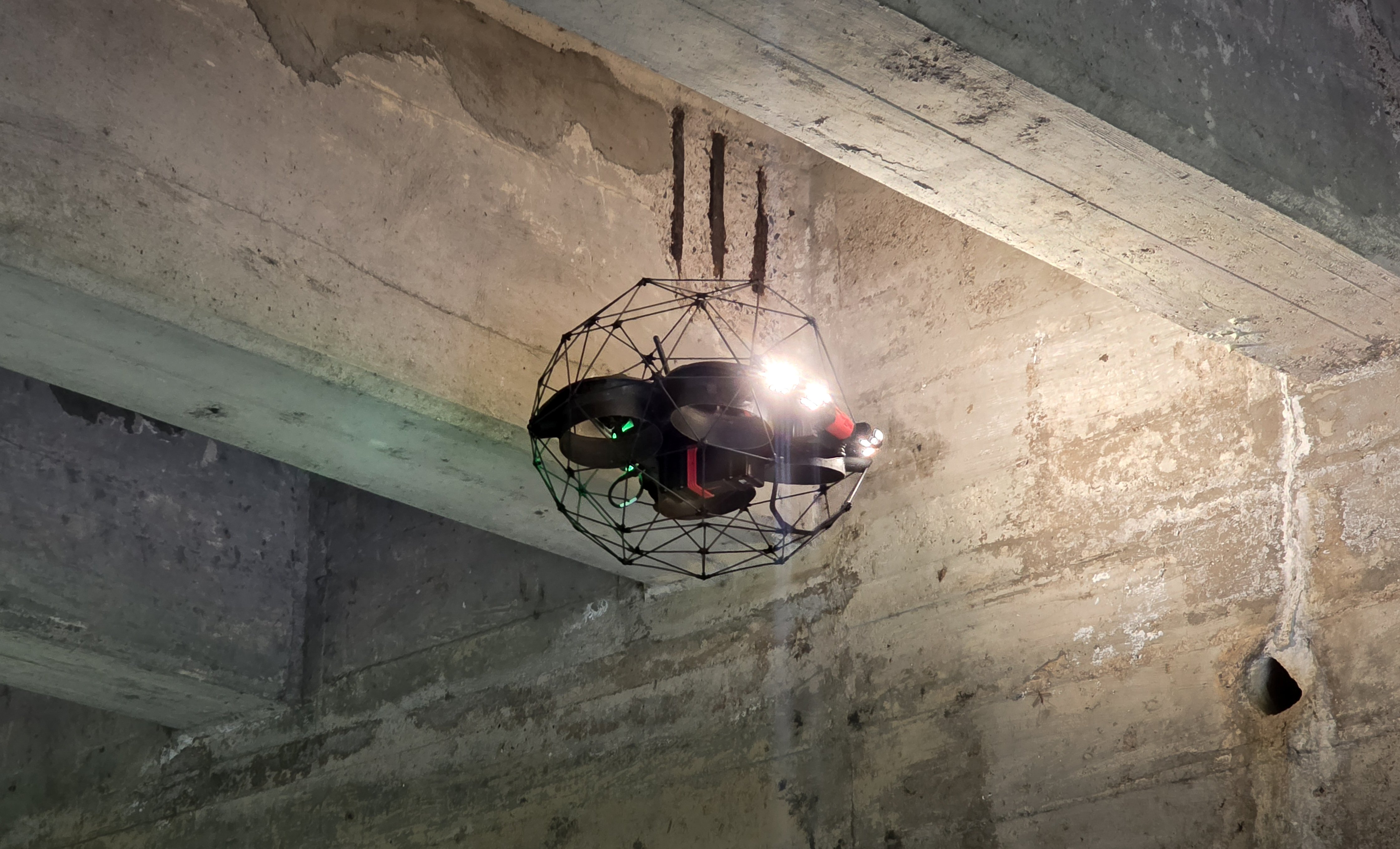
The Elios 3 is the leading confined space inspection drone, deployed for underground, interior, or complex asset inspections.
Limitations to Drone Inspections for Transport
In some countries, drones are forbidden altogether, or require strict licensing. Before deploying a drone inspection, it’s important to check that you have the relevant licenses and, if applicable, permission from local air traffic control if operating near an airfield or runway.
Some drones cannot operate in GPS-denied environments, such as underground in metro tunnels or inside bridge girder boxes. We recommend carefully assessing the types of applications you wish to use the drone for and checking that the equipment you are choosing is applicable to your use case.
If you want to see examples of how to use your Elios drone for transport inspections, feel free to check out our use cases for drones in transport!
Use Cases: Drones Inspecting Transport Infrastructure
Train Tunnel Inspection with a Drone
In the UK, a project with Newcastle Metro has been monitoring a rail tunnel and ventilation shaft since 2022. With the project nearing completion, the team wanted to check for any changes in the tunnels. One tilt sensor had moved, which was highly unusual and required investigation.
In the past, it would be necessary to use rope access or built-in ladders to gain access to the ventilation shaft. At the time, the team’s ladder access was being reviewed for certification, meaning they could not use the in situ ladders in the shaft. The project managers brought in Academy Geomatics, a specialized surveying company with extensive drone experience, to complete a remote inspection.
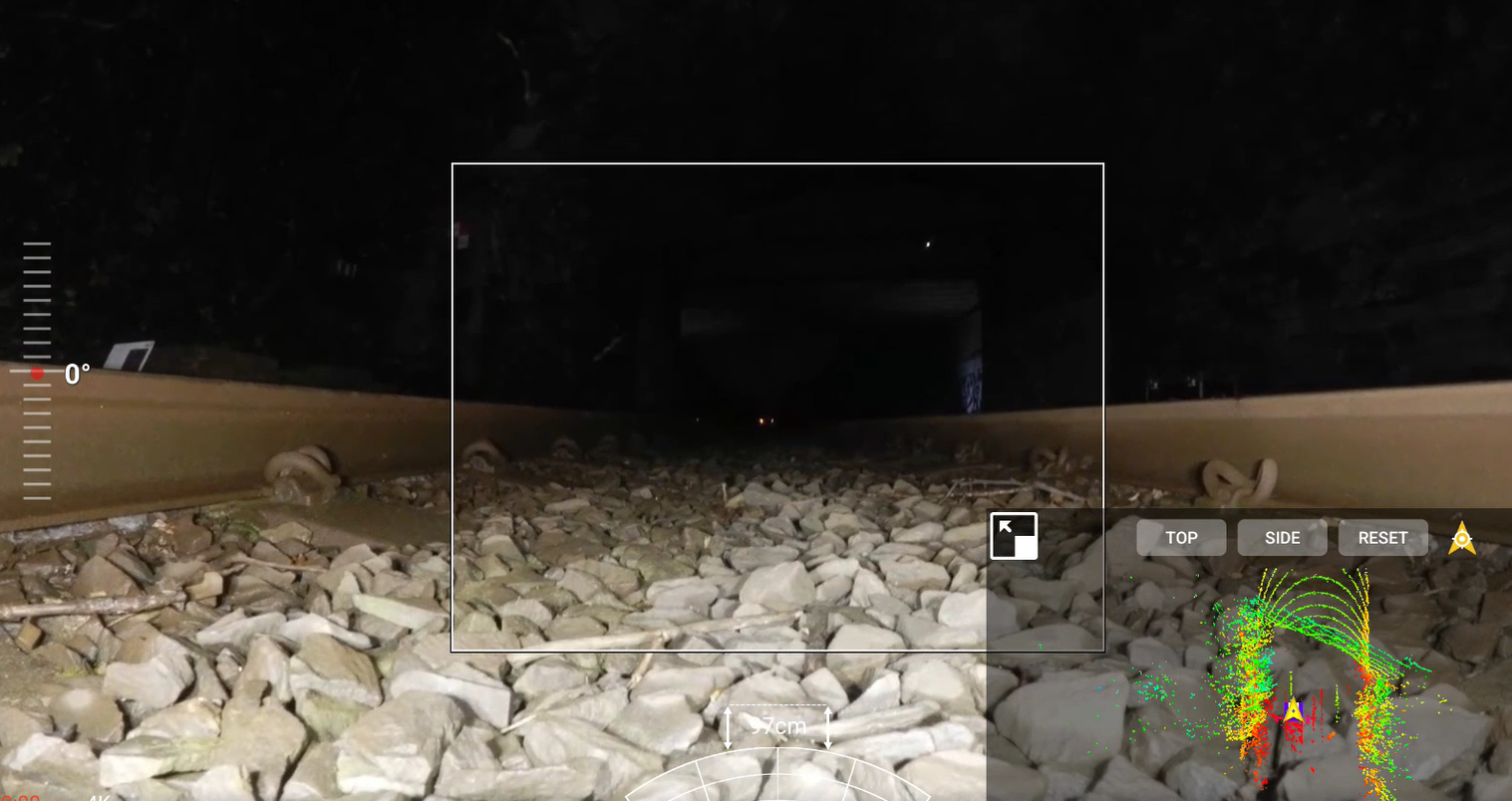
The view from the Elios 3: the drone prepares for takeoff on the rail tracks during a night shift
Academy Geomatics deployed the Elios 3, recognizing that this tunnel inspection required a drone that could operate without GPS and included special lighting systems to gather data in pitch darkness. Within one flight, the Elios 3 pilot was able to diagnose the issue with the tilt sensor. The sensor had become wet due to proximity to a joint, and the accumulation of rust had caused a slow change that registered as deformation.
Using a drone for this ventilation shaft inspection of a rail tunnel delivered quick, safe access without the need for additional certification or safety crews. In under 10 minutes, Academy Geomatics delivered clear data with their Elios 3, including 4K video and centimeter-accurate LiDAR through its Surveying Payload. The maintenance team could then plan the next steps for installing a monitoring scheme to better survey the ventilation shaft’s condition.
Station Roof Inspections with Drones
NS Stations, the Dutch Railway Authority, was facing a challenge: they needed to inspect the steel roof of a train station. The roof was built in the early 1900s, and station managers needed to check the structure for defects, rust build-up, or biological disruption (often caused by pigeons). The space between the metal weight-bearing structures and the overall roof needed careful analysis, but safe access would be impossible without complex scaffolding that would disrupt passengers. They needed to find a solution, or face planning a maintenance operation covering the entire roof, working on the assumption that the condition is a “worst-case scenario” - a project with up to 2 years of preparation required.
However, a simple, clear inspection would allow the team to get a real understanding of the roof’s condition and determine if intervention is necessary, along with the exact nature of repairs or work needed.
The NS Stations team worked with Vortex Hardware & Maintenance BV to find a solution. Together, they decided to deploy the Elios 3 drone for the station roof inspection. The Elios 3 has a protective cage around it to protect it from impact in case it crashes into the steel bars of the roof, as well as a 4K camera and centimeter-accurate LiDAR point cloud. This would allow them to capture points of interest with the camera, which are then saved in the 3D model, streamlining clear communication between the pilot and any maintenance teams.
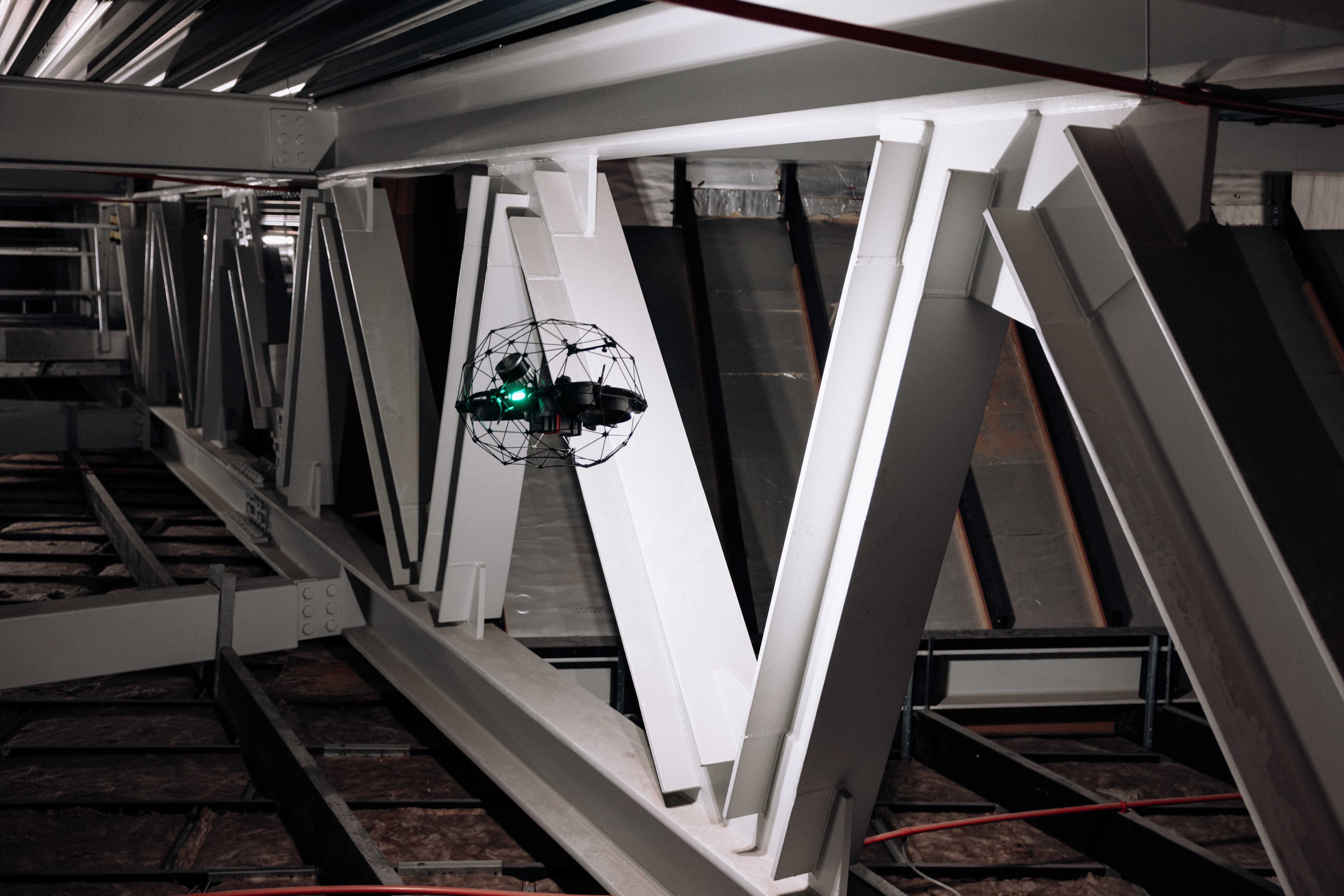
The Elios 3 flying inside the roofspace of Rotterdam Centraal, deployed for an inspection by NS Stations
Together, the NS Stations and Vortex teams planned and executed the Elios 3 drone inspection, carrying it out at night. No train rerouting or schedule changes were required, while the team stayed safely on the ground with 0 work at height. The inspection taking place at night also guaranteed no passengers were around, further simplifying the project.
Traditionally, this type of inspection with traditional methods would call for the closure of 3 train lines and planning commencing at least 13 weeks in advance. Although these inspections are only required every 10 years, their complexity makes them a challenge despite the infrequency.
Thanks to using a drone for this station inspection, the Vortex and NS Station teams completed the entire inspection in just 1 night. They determined no maintenance work was required, which immediately removed the need for any future disruption due to scaffolding. In the future, thanks to the efficiency of this inspection, the team could explore more frequent inspections of this nature. Drones empower safer and faster inspections, which in turn encourages teams to switch to predictive or preventive maintenance rather than responsive, which is more efficient in the long term.
Read the full Train Station Inspection case study with NS Stations!
Drone Bridge Inspections
A bridge inspection poses the unique challenge of inspecting both areas at height and underneath a structure. In many cases, specialized cherry pickers, rope access technicians, or hydraulic survey towers are required to gain access. This equipment can cost around 4,000 GBP (5,300 USD) per day, sharply increasing the overall inspection price. The terrain underneath the bridge poses an additional challenge - the presence of water or a large drop changes the safety protocols involved, requiring inspectors to adapt to each bridge.
Academy Geomatics has found that deploying drones for bridge inspections allows them to keep their teams safe while also collecting quality data. In two separate projects, they shared how they used drones for bridge inspections:
Spillway Bridge
A spillway bridge - passing over an area for controlled release of water - needed an underside inspection that covered the bearing area. The bearings are the areas between the bridge’s surface structure and load-bearing substructures, such as the pylons.
The Academy Geomatics team was asked to deliver visual inspections and a point cloud for use in AEC drawings as well as to assess the structural health of the bridge.
In just 2 flights with a drone, the Academy Geomatics team captured all of the necessary data without any additional equipment. They saved over 4,000 GBP that would have been required for a specialized hydraulic inspection platform, and were able to deliver high-quality data in a fraction of the time it would take traditional inspection methods.
Metro and Road Bridge
In another project, the Academy Geomatics team went to inspect a complex bridge that supports both a metro system and roadway. A full inspection, including surveying-level data, was required.
To begin, the Academy Geomatics team installed a robust survey control network on the road level and completed a terrestrial laser scan. Then, to capture the underside of the road, which was above the metro section of the bridge, they planned to return with a drone at night.
It would have been incredibly challenging to laser scan the underside with traditional methods due to the structure and size of the bridge. It would also have required the metro’s overhead line equipment (OHLE) to be isolated, further increasing the inspection costs and complexity. In combination with the work at height and need for specialized access equipment, it was clear a drone was preferable bridge inspection method.
In one flight during the night shift, the Academy Geomatics team gathered the point cloud data they needed. They could then combine this with the terrestrial laser scans from the surface to create a single, source-of-truth file. They particularly impressed their client, who had expected to have to isolate the OHLE to enable easy data collection.
Read more about surveying projects completed by Academy Geomatics with the Elios 3 drone in sewers.
Are Drones the Future of Transport Inspections?
From saving up to 5000 USD per day to being 8X faster than traditional inspection methods, it’s clear that drones have a secure place in the transport sector. The benefits of drone inspections, including improved safety, reduced work at height, and greater cost and time efficiency, make them an irresistible solution for complex transport infrastructure inspections.
Whether you’re inspecting bridges, tunnels, or other structures, it’s likely that the right drone could help you streamline your operations.
Interested in learning more? Check out what the Elios 3 drone brings to transport inspections!